
Estimated reading time: 12 minutesA hyperextended elbow is an elbow that bends past the normal range of motion, so it extends beyond the straight position.
In people with hypermobile Ehlers-Danlos Syndrome (hEDS), or hypermobile spectrum disorder (HSD), I see this often, and it can happen without them realising it. While a hyperextended elbow is not always painful, it can lead to joint instability, soft tissue injuries, and chronic pain if left unmanaged.
The good news: with the right movement strategies and awareness, hypermobile elbows can be supported effectively. This guide covers what is happening in the joint, why it matters, and practical steps to protect it.
Why write a whole blog about the elbow joint? Well, the elbow joint is like the knee joint – it is impacted by both the action of the wrist and the shoulder. It is the middleman and often ends up taking the strain for poor mechanics elsewhere.
I think elbows are underrated in how we treat and manage hypermobility. How hypermobile people use their arms is going to hugely impact elbow issues.
“Double-jointed” elbows may be just a hypermobile joint or a symptom of a more widespread connective tissue disorder like hEDS or HSD. In fact, the ability to hyperextend elbows beyond 10 degrees past the normal range is included in the Beighton criteria , a part of the current diagnostic criteria for hEDS. However, this is not a requirement for diagnosis (1).
When only one joint is hypermobile, this may be known as localized joint hypermobility or L-HSD, a subtype of hypermobility spectrum disorder that can still carry a real symptom burden (2).
It is also important to remember that hypermobility does not necessarily mean instability.
Key takeaways
Updated April 2026
- A hyperextended elbow extends beyond its normal range of motion. More than 10 degrees past straight is the clinical threshold used in the Beighton score.
- Hypermobility does not automatically mean instability, but unmanaged hyperextension increases soft tissue injury risk over time.
- Locking or snapping the elbow back turns off surrounding muscles and creates false stability. The joint is most vulnerable in this position.
- Tennis elbow, golfer’s elbow, bursitis, and ulnar nerve involvement are all more common in hypermobile elbows.
- The priority is proprioception, alignment awareness, and upper back strength, not stretching or immobilising the joint.
What is a hyperextended elbow?
A hyperextended elbow is a joint that extends beyond its normal range of motion, typically past 180 degrees.
The elbow is a complex hinge joint where the humerus (upper arm bone) meets with the two bones of the lower arm, the radius and ulna. Together, these form a hinge joint that, along with the muscles and ligaments (MCL & LCL) and nerves, can flex, extend, pronate, and supinate. The ligaments in the elbow stabilize the joint and are in constant tension through its movement; this makes them more prone to injury (3).
Muscles that surround the elbow are the biceps brachii, triceps brachii, brachialis, brachiordialis, and forearm flexors and extensors. The nerves are the ulnar, radial, and median nerves.

Hyperextended elbow vs. typical elbow: what’s the difference?
These terms are often used interchangeably, but they describe slightly different things. A hypermobile elbow is a joint that has a greater-than-normal range of motion. A hyperextended elbow is what happens when it moves into that excess range, and double-jointed is the informal, non-medical term people use to describe either.
A typical elbow extends to approximately straight, with healthy extension ranging from slight flexion to around 10 degrees past straight (3). A hyperextended elbow goes beyond that point.
Clinically speaking, hyperextension of more than 10 degrees past neutral is the threshold used in the Beighton score as one of the criteria for assessing hypermobility (1).
Note: the diagnostic criteria for hEDS and HSD are currently under review as part of the Ehlers-Danlos Society’s Road to 2026 initiative, with updated criteria expected in December 2026.
| Typical elbow | Hyperextended elbow | |
|---|---|---|
| Extension range | Approximately straight | More than 10 degrees past straight |
| Appearance | Straight when extended | Visible backward curve when extended |
| Stability | Muscles remain engaged | Muscles can switch off at end range |
What does the research say about hypermobile elbows?
There is limited research focusing specifically on hypermobility in elbows, but what is there points to increased change of soft tissue injury, altered mechanics of movement, and differences in proprioception.
Hypermobility may be related to more soft tissue issues in small joints – including elbows
In the 90s, a rheumatology clinic reported an association between soft tissue rheumatism (including tendinitis, bursitis, fasciitis, and regional pain syndromes) and hypermobility at the small joints – including elbows. The hypermobile patients also reported more recurring episodes than non-hypermobile patients (4).
A small percentage of patients report elbow dislocations, and even fewer report sprains
An analysis of EDS characteristics was done at two Italian treatment centers. Patients were included if they had joint hypermobility syndrome, EDS hypermobility type (now hEDS), or both. An average of 7.5% reported elbow dislocations, and about 1% reported elbow sprains (5).
Elbow range of motion is different during walking in adolescent girls diagnosed with Joint hypermobility syndrome
Another small study used kinematics to look at how arms moved while walking in a group of girls aged 12 – 15. Kinematics is the study of motion, or how the body moves. They used Kinematic instrumental gate analysis to assess the movement patterns and the angles of the joints as a person walks. The study found significantly more elbow flexion in the forward swing phase and a decrease in the backward swing phase compared to healthy peers, meaning the arms moved differently at the elbow throughout the gait cycle (6).
Hypermobile elbows show measurable proprioceptive deficits — but not reduced strength
A 2025 study measuring elbow and knee proprioception in 83 adults found that hypermobile individuals (Beighton Score of 5-9) showed significantly poorer sense of joint position in the elbow compared to the non-hypermobile group.
Importantly, hypermobility did not translate into weaker grip strength or diminished functional stability performance, suggesting that the core challenge in hypermobile elbows is sensory awareness rather than raw strength (7)
What problems can hypermobile elbows cause?
Hypermobile elbows are at higher risk of soft tissue injuries and chronic pain because the surrounding ligaments must work harder to compensate for excessive joint range (2,4).
I’ve experienced two episodes of elbow issues – one tennis elbow and one golfer’s elbow. Both of these are types of tendonitis (or swelling of the tendon) affecting the elbows, but they differ in their location and the tendons involved.
Golfer’s elbow or Medial Epicondylitis is pain on the inside of the elbow and involves tendons that attach to the medial epicondyle (the bony bump on the inside of the bone) of the humerus or upper arm bone. It affects the flexor muscles of the forearm.
I developed Golfer’s Elbow after just ONE golf lesson for an hour! That’s how sensitive our tissues can be. I was doing a repetitive putting motion for almost an hour, and that was enough to cause the inflammation. Top tip – avoid repetitive movements if you are hypermobile.
Tennis Elbow or Lateral Epicondylitis is pain on the outside or lateral side of the elbow. It involves tendons that attach to the lateral epicondyle (bony bump) of the humerus and mostly impacts the extensor muscles of the forearm. I developed this after a number of tennis sessions in my pre-hypermobile-aware life.
At this time, I was not aware of joint control, range of movement, or shoulder stability. I was a beginner using a tennis racket that was probably too heavy for me, and due to a lack of control and awareness, I would lock my elbow every time I hit the ball. I had both force and poor mechanics, which led to inflammation of my tissues.
Both these soft tissue injuries took many months to resolve, so if you are also struggling with one of these elbow conditions, be patient with it. Rest, ice, braces, and physical therapy or movement therapy can help.
Always see a physical therapist for help diagnosing elbow pain. These are just two common elbow conditions, but there are others, including:
Elbow Bursitis — inflammation of the fluid-filled bursa that cushions the elbow joint, more common in hypermobile individuals due to repeated soft tissue stress (4).
Cubital Tunnel Syndrome — compression or irritation of the ulnar nerve at the elbow. Ligament laxity can cause the ulnar nerve to shift out of position, producing tingling or numbness in the ring and pinky fingers (8).
Radial Tunnel Syndrome — compression of the radial nerve in the forearm, causing pain along the outside of the elbow.
Distal Biceps Tendon Rupture — a tear of the tendon attaching the biceps to the forearm.
Elbow Osteoarthritis — degeneration of the elbow cartilage, which can develop earlier in hEDS and HSD due to repeated microinjury (9).

Why locking your elbows makes things worse
When we have hypermobile elbows and haven’t learned to control them, we can often hyperextend and lock them out when we exercise; and while it feels stable, it is actually the opposite. I call this false stability, and it is one of the reasons I am not a fan of locking elbows
- When we lock out our elbows, the muscles around the joint no longer have to work, making the joint vulnerable to strain and pain. The muscles are held in a fixed position of neither lengthening nor shortening, causing faulty biomechanics.
- You turn off your powerhouse of muscles by blocking communication to the torso. The arms feed into the back, but with a locked elbow, this communication is blocked.
- This can lead to the shoulders being placed out of alignment, which may also cause neck pain.
- With locking elbows in four-point kneeling, the lumbar spine can collapse, causing strain.
- It makes any weight-bearing activity very difficult and unstable.
- In a plank pose, a locked elbow may lead to the wrists being compromised too, as too much weight is now dropping down into the ground.
My YouTube video on Exercise Modifications demonstrates this issue in practice, and I explain that organization of the shoulder girdle in weight bearing is where we need to start.
It is very hard to simply tell someone to unlock their elbows when, for that individual, the locked elbow is their stability. I call this false stability because the joint is very vulnerable in that position.
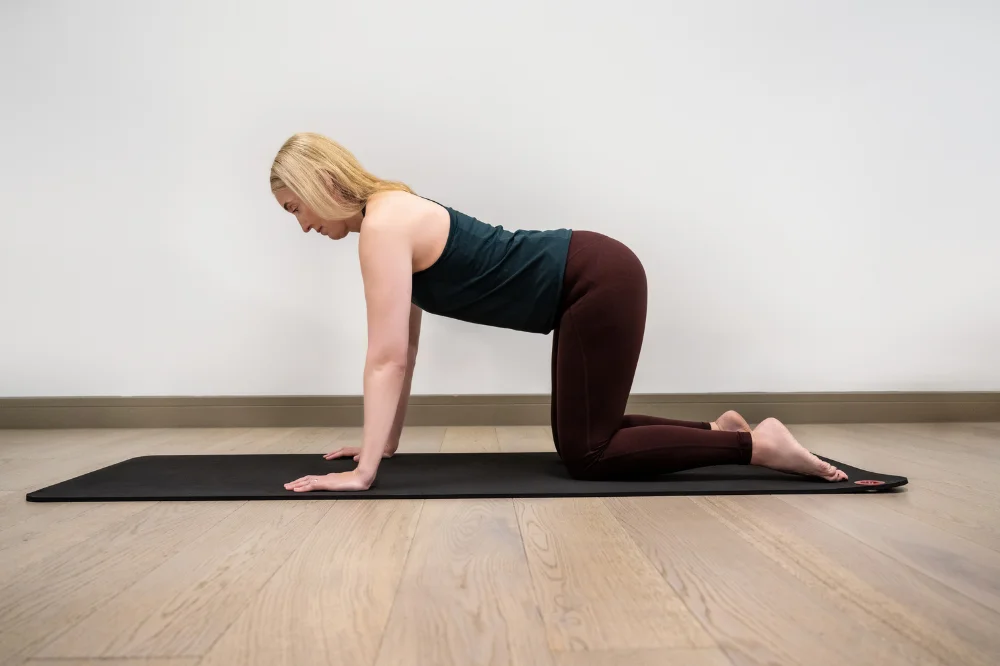
How to manage and protect a hyperextended elbow
Managing a hyperextended elbow means retraining movement patterns, building proprioception, and strengthening the upper back, not stretching or immobilising the joint.
There are lots of reasons to learn how NOT to lock those elbows. I’m not saying this will be easy because you may have done it your whole life without even realizing it. This can become a subconscious habit that you need to retrain. This takes patience and practice. How do we do it?
- There are many ways, but I would start with non-weight bearing activity and learn correct arm and shoulder mechanics. Before adding load, let’s inderstand how the arm works. Supine work (lying on the back) can help us explore arm and shoulder movement without asking the joint to do too much too soon.
- We can improve proprioception so we become aware when we do this. Proprioception is our ability to sense where are joints are in space. Research shows this is reduced in hypermobile elbows (7). If you’re not aware that you do something, you will have no idea how to change it. Once you become aware, change can happen.
- Build strength in the upper back. The elbows lock because they are trying to stabilise you, either out of habit, lack of awareness, or lack of trust that the back muscles are going to do the job. When we build strength in the upper back and posterior chain, the elbow no longer needs to compensate.
- YouTube Video: Tips for Hypermobile Elbows. In this video I walk through how to approach weight bearing without locking the elbow joints, including how to find the shoulder organisation that makes it possible.
- Teaching in The Zebra Club. Much of what I used to do in the clinic and now do in The Zebra Club is teaching people how to use their arms correctly. This is nervous system retraining — we are not just correcting a physical habit, we are changing an automatic movement pattern that the brain has reinforced over the years. It takes time, but once you feel the difference between a locked elbow and a supported one, you cannot unfeel it. My Zebra Club members often describe this as one of the most significant shifts in how they move. My video called Fix Shoulder Pain in Hypermobility can help you get started on this process.
- Ensure proper techniques. As I found out the hard way in my tennis lessons, technique matters when you have hypermobile elbows. Repetitive movement with poor mechanics is a quick route to pain. If you are returning to a sport or activity, it is worth getting a technique check before building volume — not after you are already in pain.
- Strengthening exercises for the forearm and upper arm muscles can help protect the elbow joint. Isometric exercises are a good place to start — muscle activation without joint movement builds strength without putting the elbow at risk. From there, we can progress slowly, always staying in the mid-range and avoiding the end of range where the joint is most vulnerable. In The Zebra Club, I introduce this work gradually, building tissue tolerance before adding load.
- Ergonomic adjustments at work. Daily life is often where pain starts to accumulate. Typing, carrying bags, lifting objects, and even holding a phone can cause repetitive strain when the elbow is consistently moving into hyperextension without awareness. Small adjustments — keyboard position, how you carry weight, keeping loads close to the body — can make a meaningful difference over time.”
All of this can be learned through appropriate movement practices designed for our hypermobile bodies. Remember, just because we can, doesn’t mean we should. I can lock my elbows, but I’m always trying my absolute hardest not to. It does take practice, but the fact that you become aware that you do it is the first step towards making a change.
Should you use a brace for a hypermobile elbow?
Using an elbow brace for hypermobility isn’t so much about restricting movement as it is about adding support and proprioceptive feedback. For some people, this extra sensory input can be genuinely useful during activity while they are retraining movement patterns.
In my approach, awareness and repatterning always come first. If we wear a brace and don’t also address the shoulder organization, upper back strength, and awareness, we aren’t addressing what is driving the issue in the first place.
A Physical Therapist or Occupational Therapist who understands hypermobility can help determine what works best for your situation and make sure it fits properly.
Hypermobile elbows and EDS: Is there a connection?
Elbow hypermobility is a part of the diagnostic criteria for hEDS, with an extension of more than 10 degrees contributing to the Beighton score. It is important to note that not everyone with hEDS has hypermobile elbows and not everyone with hypermobile elbows has EDS or any connective tissue disorder.
When hypermobility is limited to the elbow or a small number of joints, this may be classified as localised hypermobility spectrum disorder (L-HSD). This is not a lesser or insignificant finding — people with localised hypermobility can still experience pain, altered proprioception, and soft tissue injury, and deserve the same careful management approach.
Watch this video for some tips for working with hypermobile elbows.
FAQ
Is double-jointed good or bad?
Being hypermobile, or “double jointed” is not necessarily a bad thing. In fact, in the performing arts and some sports, hypermobility can be very beneficial. It can become a problem when hypermobility results in instability , chronic pain, or repeated injury. The goal is not to eliminate hypermobility but to build control around it.
Are hypermobile people weaker?
Research shows hypermobile individuals can have reduced muscle strength, but a 2025 study found no difference in grip strength or functional stability between hypermobile and non-hypermobile adults. The core challenge is often proprioception — the ability to sense joint position — rather than raw strength (7).
Is being double-jointed genetic?
Being double-jointed or hypermobile often runs in families and can have a genetic basis, particularly in conditions like hEDS and HSD. In other cases localised hypermobility may result from injury, surgery, or training. Being hypermobile does not automatically mean you have a connective tissue disorder.
What does a hyperextended elbow look like?
A hyperextended elbow creates a visible backward curve when the arm is extended — the forearm bends behind the line of the upper arm rather than forming a straight line. Clinically, hyperextension of more than 10 degrees past neutral is the Beighton threshold for hypermobility assessment (1).
Can a hyperextended elbow heal on its own?
It depends on whether it is an acute injury or a chronic pattern. An acute hyperextension injury may resolve with rest and physical therapy. A chronic pattern of locking and hyperextending during daily movement will likely not resolve on its own and requires movement retraining and proprioceptive work.
Why does my elbow lock up or snap back?
This is what I call false stability. When proprioceptive awareness or upper back strength is lacking, the elbow locks out at end range and the surrounding muscles switch off. It feels stable but the joint is actually at its most vulnerable in this position.
How do you treat a hyperextended elbow?
Always see a physiotherapist or medical professional for diagnosis and treatment of elbow pain. From a movement perspective, the longer-term focus is on retraining movement patterns, building proprioception, and strengthening the upper back so the elbow is better supported during activity. Awareness of the locking habit is the essential first step.
Can hypermobility cause tennis elbow or golfer’s elbow?
Yes — and I know this from personal experience. Repetitive movement combined with poor joint mechanics and lack of control is a direct route to soft tissue injury in hypermobile elbows. Both conditions can take many months to resolve. Technique and pacing matter more than most people realise.
Should I use an elbow brace if I have hypermobility?
A brace for hypermobile elbows is less about restriction and more about proprioceptive feedback — giving the nervous system more information about joint position. It can help during activity or at night if overnight hyperextension is a problem. It is a tool, not a solution. Awareness and repatterning must happen alongside it.
Are naturally hyperextended elbows dangerous?
Naturally, hyperextended elbows are not dangerous in themselves — many people hyperextend without pain or instability. They become a concern when the pattern leads to repeated soft tissue strain or chronic pain over time. The goal is not to fix the hypermobility but to build control and awareness around the joint.
Do hypermobile elbows get worse with age?
Hypermobility itself often decreases with age as connective tissue changes. However, secondary effects — soft tissue injuries, deconditioning, and chronic pain — can accumulate over time if the elbows have been used with poor mechanics for years. Proactive management at any age is far more effective than waiting for symptoms to worsen.
Why does my elbow hyperextend when I sleep?
Passive hyperextension during sleep is common in hypermobile elbows because the muscles that protect the joint during waking hours are fully relaxed overnight. Some people find a soft sleeve helpful. A physiotherapist or occupational therapist familiar with hypermobility can advise on what works best for your situation.
Is it safe to do push-ups or bench press with hypermobile elbows?
Yes, with modification. Avoid a full lockout at the top of the movement, where the elbow snaps into hyperextension and muscles disengage. Maintaining a soft micro-bend keeps the joint protected. Starting with non-weight-bearing arm work before progressing to load is the approach I recommend. My YouTube video on Tips for Hypermobile Elbows covers this in practice.

Jeannie Di Bon is a movement therapist, educator and author specializing in hypermobility, Ehlers-Danlos Syndrome and chronic pain. She is the founder of The Zebra Club app and the creator of the Integral Movement Method.

Catherine Nation, MS, PhD, holds a Master of Science in Biological Sciences and a doctorate in Tropical Medicine and Parasitology. As Marketing Content Manager at The Zebra Club and a member of the EDS community, she applies her scientific background to making complex research on hypermobility and neurodivergence accessible and accurate.
- Malfait et al. (2017) The The 2017 International Classification of the Ehlers–Danlos Syndromes. American Journal of Medical Genetics Part C (Seminars in Medical Genetics).
- Carroll, Matthew B (2023). Hypermobility spectrum disorders: a review. Rheumatology and Immunology Research.
- Downing & Sergent (2023) Anatomy, Shoulder and Upper limb, Elbow collateral ligaments. National Library of Medicine StatPearls.
- Hudson et al. (1998) The association of soft-tissue rheumatism and hypermobility. British Journal of Rheumatology.
- Morlino et al. (2017) Refining Patterns of Joint Hypermobility, Habitus, and Orthopedic Traits in Joint Hypermobility Syndrome and Ehlers–Danlos Syndrome, Hypermobility Type. Medical Genetics.
- Vorontcova et al. (2019) Kinematic instrumental analysis of the shoulder and elbow joint in normal conditions and with hypermobility of the joint in the gait cycle. Pediatric Traumatology, Orthopaedics and Reconstructive Surgery.
- Akaras et al. (2025) The effects of joint hypermobility on strength, proprioception, and functional performance. Scientific Reports.
- Granata et al (2013) Entrapment neuropathies and polyneuropathies in joint hypermobility syndrome/Ehlers-Danlos syndrome. Clinical Neurophysiology
- Hakim, A. (2024) Hypermobile Ehlers-Danlos Syndrome. In: Adam, M.P. et al. (eds.) GeneReviews. Seattle: University of Washington. Updated February 22, 2024.

2 Comments
Andie Sereikas - 21st March 2025
I have elbow hyper mobility and found this video very helpful for my yoga and Pilates practices, as well as for weightlifting. My elbows bend out further than yours. So I’m trying to use what you said to protect them. I recently started kickboxing and am now thinking it’s a bad idea to jab and hook and uppercut the bag so may have to find a different cardio workout. Thank you for posting this.
Jeannie Di Bon - 25th March 2025
So glad it was helpful in your movement practices.