
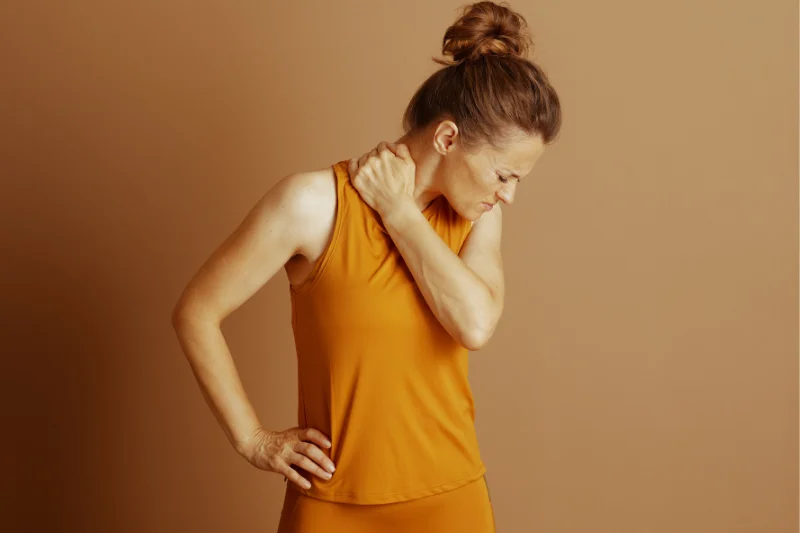
Estimated reading time: 6 minutesCoat hanger pain is a pain in the neck and upper back, specifically the suboccipital and paracervical regions. It has been described as a “charley horse” kind of sensation in the back of the neck and shoulders.
It is called coathanger pain because this pain pattern mimics the shape of a coat hanger, with the hook in the neck and the body spreading out across the upper trapezius muscles and shoulders.
Similar to headaches, this is such a common type of pain in the EDS / HSD community.
There can be several contributing factors to this pain, which we will explore in greater detail.
We need to appreciate how these work together and adopt some strategies to overcome coat-hanger pain.

Key Takeaways
Coat hanger pain spreads from your neck across your shoulders like a coat hanger shape. It’s extremely common in hypermobility and EDS.
The key sign: Pain improves when lying down (blood flow returns without fighting gravity).
Main causes: Reduced blood flow to overworked neck muscles (often associated with dysautonomia) and muscle imbalance from trying to stabilize hypermobile joints.
What helps: Hydration with electrolytes, heat, gentle strengthening (not stretching), and ergonomic changes. If lying down relieves it, discuss dysautonomia with your doctor.
What causes coat hanger pain?
Orthostatic intolerance and lack of blood flow
Coat hanger pain is very commonly found in people with conditions that affect the autonomic nervous system (dysautonomia). These can include orthostatic hypotension (OH), multiple system atrophy (MSA), and POTS (1, 2, 3).
Why does lying down make it better?
Lying down allows the blood flow to return to the area without fighting gravity.
Coat hanger pain that improves with sitting or lying down is listed as a symptom in a recent article for providers on how to assess autonomic conditions (4).
One theory suggests that because the neck muscles are anti-gravity muscles and are always actively supporting the neck, they are continuously using the oxygen that is delivered to them in the blood.
If the blood flow falls below what is needed (which can happen in people with orthostatic intolerance), the waste products of the muscle activity build up, which can lead to pain (4).
The lack of blood flow may not be the whole picture
In one study of people with orthostatic hypotension (low blood pressure with standing), 59% reported coat hanger pain during their daily activities (3).
This study also found that there was a high degree of variability in patients in the severity of the pain, the presence of other symptoms, and how long people needed to recover after lying down.
Researchers suggest this variability is due to the complexity of the condition and that it is probably not just a lack of blood flow to the muscles.
Stimulation of other structures in the head and neck can produce the same pain pattern.
They even mention that many of their patients had a loss of vagal nerve function that could alter the headache threshold (3).
Muscle tension patterns may contribute
I often see this pain pattern in my clients who have a particular pattern: tight muscles at the front of the body and long, stringy muscles in the back body.
We are out of balance, so muscles fatigue and complain, leaving this nagging daily pain.
Our posture tends to mimic this with a forward slump and rounded shoulders, maybe a winging scapula. Forward head posture and associated neck pain can follow.
Interestingly, you may also find with this type of posture that a neck hump is developing on the back of your neck. People are often concerned about this development.
The reason behind this hump on the back of the neck is due to a laying down of fascia. Fascia responds to force and pressure traveling through the connective tissue.
With a forward head posture, the head weight increases significantly, causing shearing on the vertebrae.
The body begins to lay down a fat pad with fascia over time to protect the joints. With appropriate treatment, exercise, and posture, I see these fat pads diminish in my clients.
The fascia has an amazing ability to remodel itself. If we change the forces traveling excessively through a couple of joints, we can change the presentation of the fascia.
While the cause of coat-hanger pain is believed to be multi-factorial, both dysautonomia and postural issues could likely contribute to the lack of blood flow to these muscles, leading to pain.
The good news is that there are things to try to manage this pain. We will discuss this below.
Identifying symptoms of coathanger pain and the diagnostic process
It is always important to see a medical professional, like an EDS-aware physical therapist if you are experiencing new types of neck and shoulder pain.
They can help identify the cause of the pain, and appropriate manual therapy may be useful in relieving some of the pain symptoms, so that you can start to exercise and bring balance to the structure.
I have a list of providers who have been trained in my Integral Movement Method, many of whom are physical therapists and physiotherapists.

A woman sits on the floor in front of her couch drinking a glass of water.
Home management strategies
There are many strategies we can try to alleviate this condition. Some of these include:
- Hydration
- Maintaining hydration can reduce orthostatic and coat-hanger headaches due to dysautonomia (5). This may involve electrolytes and salt.
- Heat
- Using a heating pad on the upper back may increase blood flow to the area and relax the overworked muscles.
- Movement
- This can help increase blood flow to the area and hydrate the fascia.
- Counterpressure maneuvers to get the blood pumping back to the head (6)
- Things like leg-crossing, calf pumps, squatting, etc.
- Address posture and strength
- We can change the coat hanger so that it holds us up in alignment, rather than feeling the coat is too heavy! Exercise can really target this area.
- Address pain sensitization
- Addressing nociplastic pain through nervous system regulating strategies
- Breathing
- Starting with supine breathing exercises can help relax the muscles. Using gravity to allow the bones to settle can release habitual tension from the upper back tissues. Once we have relaxed those muscles, we can start implementing some appropriate hypermobility/EDS stability and strengthening exercises. Want to try some breathing exercises? Check out this video.
- Ergonomics
- It can be worth addressing ergonomic desk setup or driving positions to make sure we are not exacerbating a coat-hanger position during our daily activities.
Emily Rich, OT, PhD joined us in The Zebra Club. and gave a fantastic presentation on the non-pharmacological management of POTS.
Members can find this in the resource section in Expert Insights. This will provide additional resources for addressing postural orthostatic challenges that contribute to coat-hanger pain.
When should I get professional care?
If you have new or sudden neck or shoulder pain or if pain suddenly worsens, it’s always best to consult your medical team.
If you find that your coat-hanger pain improves with lying down, it may be especially beneficial to discuss with your doctor; this can be a symptom of many different types of dysautonomia.
Many things can be done to address some of the symptoms of dysautonomia, from medication to lifestyle interventions like salt intake and compression. Dysautonomia International has a provider’s directory that may help.
Video: 5 Best Exercises for Coat hanger Pain
Want to try some exercises to start to address your coat hanger pain? Here is one video I created to address this.
If you like that one, I have a full-length Coat Hanger Pain class created by popular request. This one has been very popular since I added it to the video library in The Zebra Club.
FAQ
What does a coat hanger pain feel like?
Coat hanger pain can feel like increased tension, cramping pain, aching, burning, or other painful sensations. It occurs along the upper back or traps, out towards the shoulders, and up into the neck in the shape of a coat hanger.
What is the coat hanger effect?
The coat hanger effect refers to the coat-hanger-type pain in the neck and upper back that is often associated with conditions that affect the autonomic system.
How to get rid of coat-hanger pain?
Some strategies to lessen coat hanger pain include heat, hydration, lying down, movement, and counterpressure maneuvers. Working on strengthening this may help. If lying down does help significantly, it may be worth talking to your doctor about dysautonomia.
Why does EDS cause coathanger pain?
Coathanger pain can be due to a lack of blood flow to the upper back and head, due to blood pooling related to dysautonomia. It can also be a result of forward head posture, which is more common in ligament laxity. It is a complex condition that may take a multifactorial approach to address.
Why does lying down make coat-hanger pain feel better?
This is a hallmark symptom of dysautonomia and is likely due to allowing blood flow to return to the muscles. It also takes away the impact of gravity and having to hold the head up if there is a muscular imbalance contributing to the pain.
Why does massage make my coat-hanger pain worse?
In EDS and hypermobility, muscle tightness is often a protective response—your larger muscles are compensating for weak deep stabilizers. When massage releases this tension too aggressively, your body loses what little stability it had, causing muscles to tighten right back up in an attempt to protect unstable joints.
Updated January 2026

Jeannie Di Bon is a movement therapist, educator and author specializing in hypermobility, Ehlers-Danlos Syndrome and chronic pain. She is the founder of The Zebra Club app and the creator of the Integral Movement Method.
Literature review/research by Catherine Nation MSc, PhD
Works Cited
- Cook & Sandroni (2018). Management of headache and chronic pain in POTS. Autonomic Neuroscience: Basic and Clinical.
- Bleasdale-Barr & Mathias (1998). Neck and other muscle pains in autonomic failure: their association with orthostatic hypotension. Journal of The Royal Society of Medicine.
- Khurana (2012). Coat-hanger ache in orthostatic hypotension. Cephalgia.
- Goldstein & Cheshire (2017). The Autonomic Medical History. Clinical Autonomic Research.
- Arca & Singh (2021). Dehydration and Headache. Current Pain and Headache Reports.
- Williams et al. (2022). Counter pressure maneuvers for syncope prevention: a semi-systemic review and meta-analysis. Frontiers in Cardiovascular Medicine.

4 Comments
Annemarie - 19th March 2026
Thank you so much Jeannie. For years I thought my coat hanger pain was inflamed tendons. It is so helpful to have all this information and practical advice.
Jeannie Di Bon - 25th March 2026
Thank you – so glad this was helpful.
Ian Mitchell - 20th February 2024
Where can we find the links to the YouTube series you mentioned?
Jeannie Di Bon - 22nd February 2024
Thank you. Here is a link to my YouTube channel.
Jeannie di Bon on Youtube