Estimated reading time: 10 minutesKnees are hypermobile when the knee joint moves beyond its normal range. For some, this can lead to instability, pain, and increased risk of injury.
In fact, it has been reported that the knee was second only to the shoulder in terms of problematic joints in people with Ehlers-Danlos Syndrome (1). This can manifest as hyperextension, instability, subluxation, or issues with the patella (kneecap).
This is a complaint I hear often from the community. I used to adopt the strangest of standing postures, from simple knee locking to crossing one leg over the other, or actually wrapping one leg around the other one.
There are a number of strategies that can help support the knee joint, including exercise, bracing, and awareness training.
Key Takeaways
- Hypermobility is not always a problem. Many people have hypermobile knees without symptoms. It is when hypermobility becomes symptomatic, or is part of a connective tissue disorder like hEDS or HSD, that support becomes important.
- The knee is the middle man. Foot and hip alignment both directly affect the knee. A whole-body approach to movement is key.
- Subluxation is common and real. Nearly 1 in 4 people with EDS experience knee subluxation. It does not need to be a full dislocation to be painful and disruptive.
- Hyperextension has a chain reaction. Locking the knees affects the pelvis, glutes, low back, and even the neck. Finding a soft knee is one of the most impactful changes you can make.
- Start with proprioception, not strength. Loading a hypermobile knee before it has learned to control its range can make things worse. Awareness and control come first.
Updated March 2026
How hypermobility affects the knees
Hypermobility in itself is not always a problem; many people have hypermobile knees without any symptoms.
But when hypermobility becomes symptomatic, or is part of a connective tissue disorder like hEDS or HSD, the knee joint can struggle to stabilise itself, leading to pain, instability, patellar tracking issues, and subluxation
Increased Risk of Injury
The excessive range of motion associated with hypermobility can make the knee joint more susceptible to injuries such as dislocations, sprains, and strains. This is because the supporting ligaments and muscles may not provide adequate stability. When we lack control around the knee joint, we may lose control quickly under load or force, causing injury (2)
Joint Pain
The knee joints may become sore and tired more quickly due to the extra movement and the effort required to maintain stability. Learning to stabilise the knee joint is key.
Osteoarthritis
Over time, the increased wear and tear on hypermobile knee joints can lead to early-onset osteoarthritis. The cartilage that cushions the knee may degrade faster, leading to pain, stiffness, and reduced function.
Patellar Instability
Hypermobility can lead to issues with the kneecap (patella), such as patellar instability or dislocation. This occurs when the patella moves out of its normal alignment, causing pain and discomfort. Pain under or around the kneecap, sometimes called patellofemoral pain, is a common presentation. Patellar instability is one of the leading causes of subluxation in hypermobile knees (3).
Subluxations
While instability is one of the most common features of hypermobile knees, subluxations are one way this appears. A subluxation is a partial dislocation where the joint shifts out of position but returns on its own.
At the knee, this most commonly affects the kneecap and can be acutely painful even without a full dislocation. Research shows that among people with EDS, subluxation is the third most commonly reported knee complaint, affecting nearly 1 in 4 (3).
Muscle Imbalances
Like in any other part of a hypermobile body, the muscles around the knees may become imbalanced. Some muscles may overcompensate for the lack of joint stability, while others may weaken, leading to an increased risk of injury and pain.
Issues with proprioception
People with hypermobility often have impaired proprioception (the sense of joint position and movement). This can affect balance and coordination, making activities that require precise knee movements more challenging and increasing the risk of falls. The hyperextension of the knees that we frequently do can impair proprioception, but there are some great exercises to improve this.

Blausen.com staff (2014). “Medical gallery of Blausen Medical 2014”. WikiJournal of Medicine 1 (2). DOI:10.15347/wjm/2014.010. ISSN 2002-4436., CC BY 3.0 <https://creativecommons.org/licenses/by/3.0>, via Wikimedia Commons[anchor id="section3"]
Hypermobile Knees vs. Normal Knees
Hypermobile knees extend beyond the normal range of motion, often bending a little backwards when standing instead of stopping in a straight line.
The clearest sign of a hypermobile knee is a slight backwards curve when standing, or a hyperextended knee. The knee locks out and presents with a subtle backwards or C-shaped curve. A typical range of motion would result in a straight or just short of straight knee when standing.
Knee hypermobility, sometimes referred to as a “double-jointed” knee, is also included in the Beighton score, a part of the 2017 diagnostic criteria for hypermobile Ehlers-Danlos Syndrome. When the knee has greater than 10 degrees of hyperextension, 1 point is earned for each side.
What are the causes of the pain?
Hypermobile knee pain is usually caused by many factors, rather than just one. This can be a combination of joint laxity, muscle imbalance, and altered loading patterns.
My first occurrence of knee pain was when I was around 12 years old and a cross-country runner. I developed crippling pain under both kneecaps, what we now know as patellofemoral pain. Intense physiotherapy and quad-strengthening solved that issue
Other things I see often that can contribute to knee pain:
- Patella tracking issues, subluxation, and dislocations: The kneecap can move out of normal alignment, especially with load and fatigue — this is sometimes called patellofemoral pain (3).
- Knee locking and hyperextension: The constant locking of knees is also going to pull the bones out of alignment, placing them under more stress. Stress can cause irritation and inflammation, causing further pain.
- Gait changes: research shows that people with hEDS and HSD walk differently, with measurable differences in knee flexion and extension during movement (4,5)
- Fascial changes: research has identified altered fascial thickness and stiffness in the iliotibial tract in people with hEDS and HSD, which may contribute to knee problems (6).
- The knee as the middle man: foot alignment and pelvic alignment both directly affect the knee. This is why a whole-body approach to movement is key. A problem at the foot or hip will often show up as knee pain.
Walking and climbing stairs can become really challenging when knee pain is present. Loading the joints correctly when going up and down stairs makes a significant difference. With improved technique, it is possible to reduce the strain on the knee considerably. This is something I work on with clients regularly.
Some people also find that taping provides additional proprioceptive feedback and support. If that interests you, it is worth discussing with your physical therapist (especially if hypermobile-aware), physio or OT. Our focus here is movement-based support.
The good news is that all of these can be addressed with movement therapy.
Why should we address knee hyperextension?
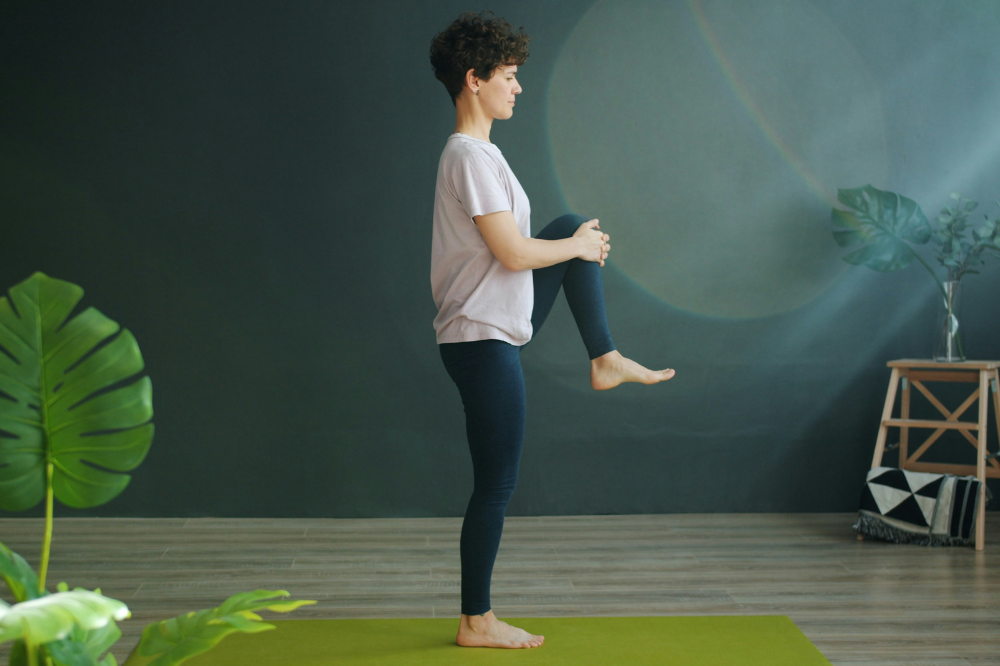
Hyperextending the knees might feel like a natural resting position, but it places the whole body under unnecessary strain.
Before I learned about movement, gait, and hypermobility, standing with hyperextended knees was my natural position. Now that I know better I can share why I think we should avoid hyperextending our knees.
- It puts pressure on the knee joint— sustained hyperextension causes wear and tear over time.
- The leg muscles switch off— when the knees lock, you are hanging off the joint rather than being supported by muscle. Body weight shifts forward, and the toes often grip the floor to compensate.
- The pelvis tilts forward— this shortens the muscles at the back, tightens the hamstrings, and can contribute to low back pain. The abdominals also push forward, losing their natural tone.
- The glutes don’t engage— in a hyperextended position, the glutes are largely inactive, which has knock-on effects for walking and hip stability.
- The head follows the pelvis— the whole chain shifts forward, which can lead to neck pain and headaches.
We know that there should be a low level of muscle activity in standing. When the big bony structures of the head, ribs, and pelvis are out of alignment, the body is put under much more strain than is necessary.
Bringing these structures into alignment lets the body conserve energy and work less. Gravity is harnessed when our body weight is balanced.
Finding a Soft Knee
To address knee hyperextension, I like to teach what I call the soft knee. It is not necessarily a full bend, just not locked. With softened knees, you can bring those structures back into alignment.
Start standing and feel your feet. It is important to get a sense of gravity by drawing the feet heavy into the ground. The knees will naturally soften.
It is very difficult to lock out the knees when you are truly in your feet with balance evenly distributing your weight to the front and back of the foot. Gravity is drawing your weight down.
Have a play – it will take practice and will not fix overnight, but it’s definitely worth the investment in time.
Why hypermobile knee pain comes and goes
If your knee pain seems to have a life of its own, you are not imagining it.
Flares are a temporary worsening of symptoms, and they are very real. For the knee this might mean a day where pain is significantly higher, the joint feels more unstable, or walking becomes much harder than it was yesterday. It does not mean you are going backwards.
I used to think flares only happened after physical overexertion. I now know it is rarely that simple. Fatigue, poor sleep, stress, and hormonal changes can all contribute, often in combination. Something I hear regularly from our community is that knee pain can appear the day after activity rather than during it. That delayed response makes it easy to accidentally do too much.
If you experience regular flares, try to avoid the boom and bust cycle. Start low and go slow, and build tissue tolerance gradually over time. [Read more about managing flare-ups here.]
The nervous system and knee pain in hypermobility
Knee pain in hypermobility is not just a mechanical problem. The nervous system and fascia are part of the picture too, and understanding this can help explain a lot.
Proprioception is the sense of where a joint is in space and how it is moving. Research shows this is altered in people with hypermobility (7). Fascia plays a key role in this. It is rich in sensory nerve endings and acts as a signalling system for the body. In hEDS and HSD, we know that fascial changes can affect how well that sensory information gets through. Read more about fascia and proprioception in EDS.
On top of this, the nervous system can become sensitised over time. Dr. Leslie Russek describes it as the pain dial being turned up. When this happens, pain can feel disproportionate to what is actually going on in the knee, or persist without an obvious cause. This is well recognised in EDS and HSD, and it is not in your head. Read more about pain types in hypermobility.
This is why we always begin with proprioception and awareness before any strengthening work. We need the nervous system to feel safe first.
Are braces any good for your knees?
I believe using braces to help support our joints, like the knee, can be helpful in alleviating pain. Braces can help with proprioception, alignment, and daily activities. In a study on treatment modalities used by people with EDS, 70% reported improvement in pain with the use of Occupational Therapy and Bracing (1). If we are using braces, we do still want to do movement and exercise to improve strength and stability around the knees.
There is a common myth that braces are bad for EDS. I addressed this directly on YouTube. Braces can help with proprioception, alignment, and daily activities. The key is that we still want to work on movement and exercise alongside any support we use, rather than relying on bracing alone.
If you are considering a brace, a physio, OT, or orthotist can help you find the right type of support for your specific presentation.

Exercises for hypermobile knees
Exercise is one of the most effective tools for managing hypermobile knee pain. But where you start really matters.
One of the most common things I hear from people in our community is that standard physiotherapy exercises made their knee pain worse, not better. This is not unusual, and it is not their fault. Most conventional strengthening protocols skip a crucial step. They go straight to load and resistance without first establishing proprioception and joint awareness. For a hypermobile knee that has spent years hyperextending, that approach can be counterproductive.
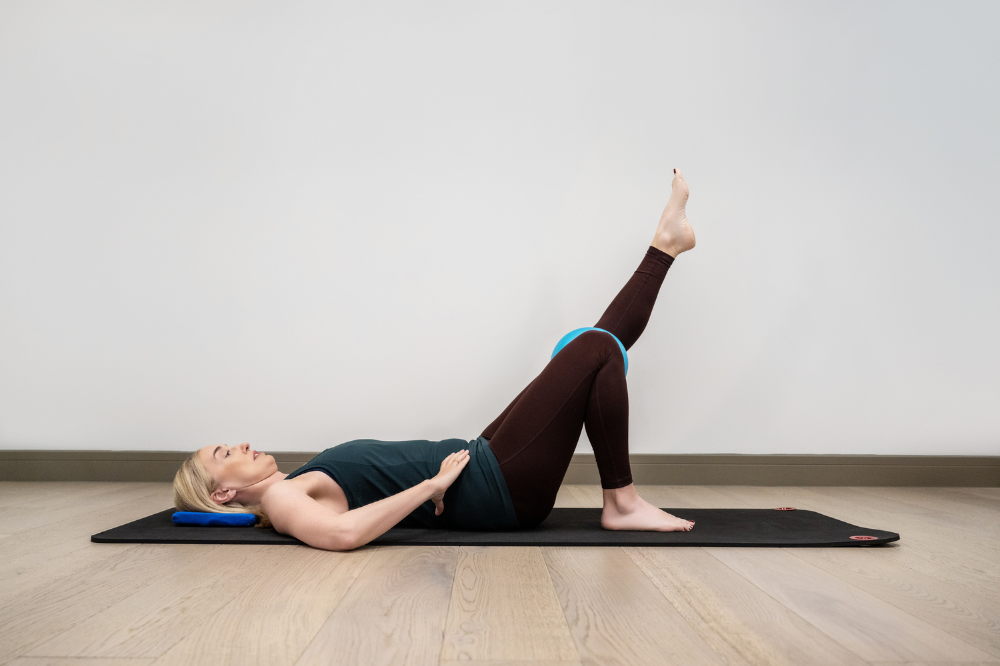
In the Integral Movement Method (IMM approach), we always start with proprioception. There is no point in loading a knee that has not yet learned where it is in space. We build awareness and control first, then introduce stability, and only then progress to strength work. Go low and go slow.
It takes time. If like me you have spent most of your life with hyperextended knees, the body will want to keep returning to that. Keep practicing, and control will come.
I have a range of knee exercises on YouTube, and in The Zebra Club, we have a dedicated lower limb programme including a class specifically designed to support the knee joint.
Video: The Hypermobile Knee: Subluxations & More
This is one of my most requested classes. If you have EDS or hypermobility and your knees are giving you trouble, this is a good place to start. I share my own experience with hypermobile knees before moving into a gentle practice addressing the most common issues. You will need a small ball or cushion and a resistance band. Jump to 5:12 to go straight to the movement.
If you found this post helpful, there is a lot more where it came from. Join my newsletter community for regular insights on hypermobility, movement, and managing EDS. [Sign up here.]
FAQ
What are hypermobile knees?
Knees are hypermobile when the knee joint moves beyond theexpected range, most commonly seen as hyperextension. This is due to differences in connective tissue rather than muscle flexibility. Hypermobile knees are not always symptomatic, but when they are, they can cause pain, instability, patellar tracking issues, and subluxation.
Do knee supports help hypermobility?
Bracing and support can help with hypermobile knee pain. Research shows 70% of people with EDS reported improvement in pain with the use of occupational therapy and bracing. Braces can help with proprioception, alignment, and daily activities. We still want to work on movement and exercise alongside any support we use.
What is the difference between a knee subluxation and a dislocation?
A subluxation is a partial dislocation where the joint shifts out of position but returns on its own. A full dislocation means the joint stays out of place and usually requires manual repositioning. Both can be acutely painful. In hypermobile knees, subluxation most commonly affects the kneecap and can happen with minimal force.
Can hypermobility cause knee pain even without an injury?
Yes. Hypermobile knees can cause persistent pain without any specific injury. The combination of joint laxity, muscle imbalance, altered proprioception, and a sensitised nervous system can all contribute to pain during everyday activities like standing, walking, and climbing stairs. This is very common in people with hEDS and HSD.
How do you treat hypermobile knee pain?
Managing hypermobile knee pain often involves a combination of approaches. From a movement perspective, we start with proprioception and joint awareness before progressing to stability and strength work. Bracing can provide additional support alongside movement. Because the knee is affected by foot and hip alignment, a whole-body approach to movement is key. Always work with your healthcare team to find the right combination for you.
Why do standard physiotherapy exercises sometimes make hypermobile knee pain worse?
Because most standard physiotherapy protocols start with strengthening without first addressing proprioception and joint awareness. For hypermobile knees, this can be counterproductive. If the knee has not learned where it is in space, loading it can increase pain and instability rather than reduce it. Starting with awareness and control first makes a significant difference.
What exercises help hypermobile knees?
The best exercises for hypermobile knees start with proprioception and awareness rather than conventional strengthening. Once joint control is established, stability work can be introduced, followed by gradual progressive loading. High impact exercise and end range loading are best avoided until good control is in place. Go low and go slow.
How do you strengthen hypermobile knees safely?
Start with proprioception exercises to build joint awareness before introducing any load. Once you have control of the range of movement, introduce stability work, then progress gradually to strengthening. Avoid locking the knees during any exercise. In The Zebra Club we have a dedicated lower limb programme to guide you through this safely.

Jeannie Di Bon is a movement therapist, educator and author specializing in hypermobility, Ehlers-Danlos Syndrome and chronic pain. She is the founder of The Zebra Club app and the creator of the Integral Movement Method.
Literature Review and Research by Catherine Nation, MS, PhD
- Song et al. (2020). Systemic manifestations of Ehlers-Danlos syndrome. Proceedings (Baylor University. Medical Center)
- Sundemo et al. (2019) Generalised joint hypermobility increases ACL injury risk and is associated with inferior outcome after ACL reconstruction: a systematic review.
- Heighes et al. (2024) The relationship between joint hypermobility and patellar instability: A systematic review. Journal of Orthopaedics.
- Galli et al. (2011) Gait strategy in patients with Ehlers–Danlos syndrome hypermobility type: A kinematic and kinetic evaluation using 3D gait analysis. Research in Developmental Disabilities.
- Celletti et al. (2013) Use of the Gait Profile Score for the evaluation of patients with joint hypermobility syndrome/Ehlers–Danlos syndrome hypermobility type. Research in Developmental Disabilities.
- Wang et al. (2021) Fascial thickness and stiffness in hypermobile Ehlers‐Danlos syndrome. American Journal of Medical Genetics Part C: Seminars in Medical Genetics.
- Hall et al. (1995). The effect of hypermobility syndrome on knee joint proprioception. British Journal of Rheumatology.

2 Comments
J - 25th August 2024
Do you recommend any particular UK braces, please?
Jeannie Di Bon - 28th August 2024
Glad it was helpful. Sorry, I don’t have any particular braces I recommend. Best to speak to a physio or OT who would have more information on suitability.